




GUNNER ASSISTANCE
Let's talk a little about gunner assistance. Most of you know that when you send your dog on a mark, especially a young dog that is just beginning, the last thing you want to do is handle if your dog has difficulty. If you are training with multiple people the gunner will say "hey, hey", slowly walk toward the fall area, move their arm, or any other type of activity to help the dog stay in the area and find the mark. If you are training alone with a single shot launcher once you send the dog for the mark how can you help your dog to find the mark if they need it? Suppose your dog puts on a GREAT hunt in the fall area but gets slightly confused and starts to leave the area, if you can't help them you can't be ultimately successful in teaching the proper behavior.
Many people will use an audible signal from the receiver on the electronics to keep the dog in the area. This is a viable approach but not always successful. There have been many occasions where the dog has difficulty correlating the sound with the fall area. I have utilized the multiple shot launcher training on any gun stations not manned with a live person to discharge another bumper when the dog is to a point where they can be helped. Maybe they have just left the area and the audible signal wasn't successful. Maybe they are breaking down before the fall and you want to increase momentum. Maybe they are getting tired and you want to discontinue their hunt with success before failure. All of these scenarios dictate the ability to shoot another bumper into the same spot.
You can also see why, even if you only have a couple dogs, multiple shot launchers can be very beneficial. On difficult marks I have often used all of the bumpers for just a few dogs.
SCENTED BUMPERS
Everyone knows that a dog uses their sense of smell to find fallen game. It is a key skill for hunting and competition events (What a revelation, impressed yet?) The difficult part is training your dog to consistently find game smell when using plastic bumpers. When was the last time a duck of pheasant smelled like plastic? It is also very difficult for amateurs to consistently use birds in their training setups.
The Thunder bumpers are specially designed to hold scent without being "damaged". Plastic does not retain large amounts of scent and more scent equals more success. If you dog marks great but can't find the bumper due to scent issues it can ruin a good training session in a hurry. Some people switch to canvas when training on scent because it hold more smell but they bumpers are not as durable and become discolored which prohibits visual identification and decreases marking success.The Thunder bumpers are made of a durable plastic material surrounded with a soft, flexible outer shell. This material is very durable and holds scent without becoming discolored.
Two approaches can be used to scent the bumpers; when you are using birds store the bumpers with them or use an off the shelf scent formula. You can squirt a few drops of the scent on the soft shell and it will hold scent for weeks. I personally like to store my bumpers with birds whenever possible. Try this just one time and watch your dogs success improve substantially.
SEED THE FALL AREA
Building off the scent discussion from above is the idea of "seeding" the area of the fall. Many trainers will place one or multiple birds (depending on the amount of dogs) in the area where the launcher bumper will be shot. The dog sees a white bumper shot into a particular area and when they arrive at the fall SURPRISE there is a bird in the area. This can ensure success using their nose and hunting the area of the fall. It will also build momentum for retrieving bumpers because they never know if there is a bird at the end.
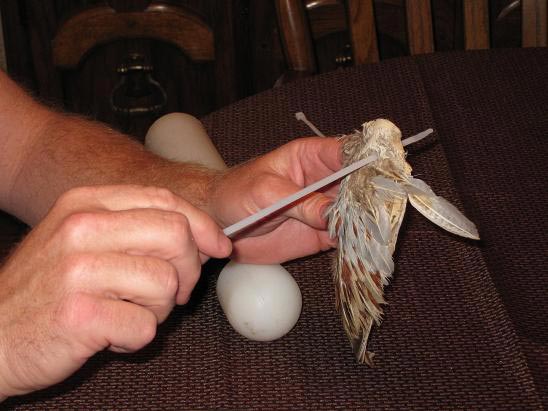
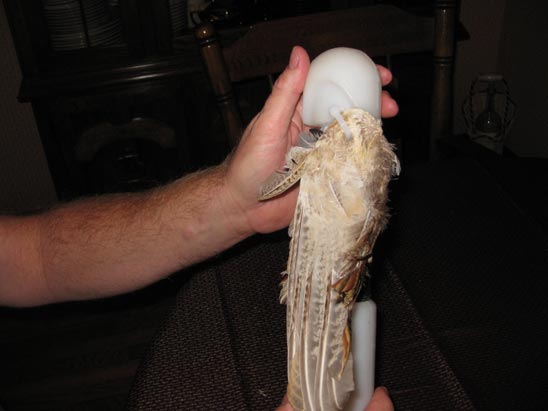
Step One: Drill a 1/4" hole in the forward part of the wing joint. Put a zip tie through the hole. Don't engage the zip tie yet.
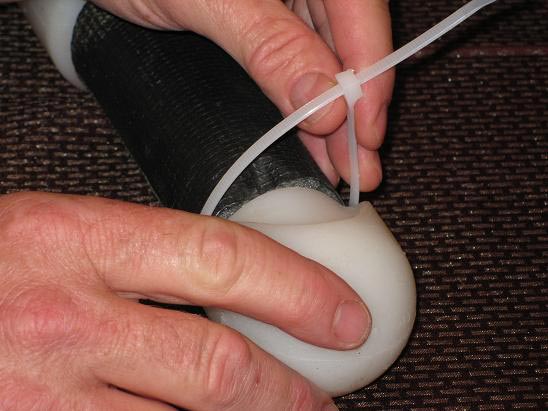
Step Two: Put a zip tie around the bumper, just behind the larger diameter "nose", but in front of the vinyl padded collar. Engage this zip tie but don't tighten.
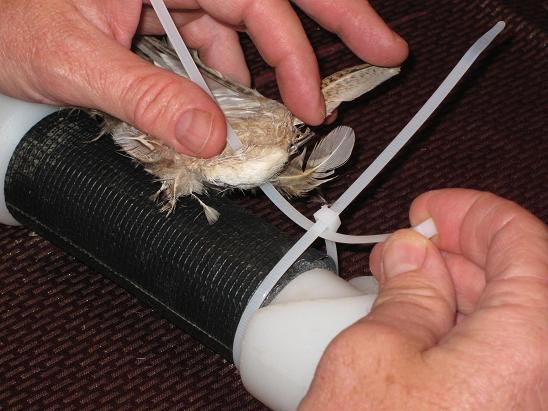
Step Three: Slip the bird wing zip tie under the bumper zip tie to where the bird wing will lie beside the bumper
Step Four: Tighten the bird wing zip tie fairly snug.
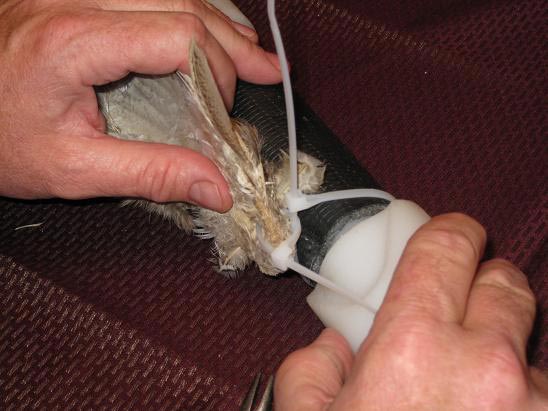
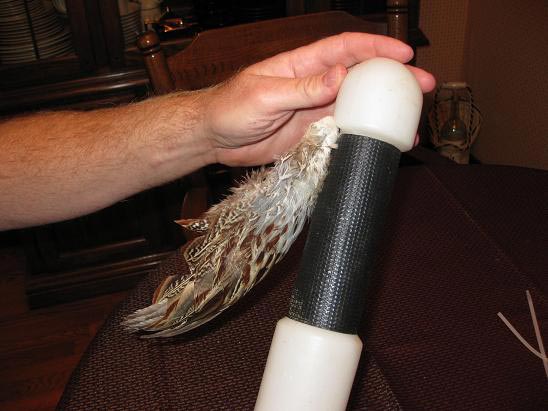
Step Five: Tighten the bumper zip tie very tight so that the zip tie disappears between the expanded nose of the bumper and the padded collar.
Finished Bumper
You can also seed the "money" bird. In order to ensure success for beginning dogs and teach marking concepts a multiple mark setup should have one clear concept to focus on. Many times amateurs training in a small group will put their human bird thrower at that station. If you have limited help or don't have the luxury of multiple people you can combine the concept of seeding the fall area with gunner assistance and achieve great results.
I would caution that you need to be careful what mark and area you seed. It is not advisable to run a dog past a "seeded" area to another fall. In other words, don't put a pile of birds right in the middle of your marking test. I guarantee this will cause problems. The process I describe above is normally used for long singles or birds well outside or long of a multiple mark setup. Just be careful and be diligent in determining wind direction and other factors that could lead to your dog switching back to a seeded pile. My suggestion, when unsure about conditions, don't seed. When done properly you will see great success.
CAMO BLIND
When preparing for hunting or hunt tests many people do not want their dog to be able to see the launcher out in the field. I have found a great solution. Avery makes a product called Fast Break Ground Blind - 6' which sells for $13.99 at Cabelas. This low-profile, ultra-compact design has a durable die-cut, non-woven camo fabric, along with lightweight fiberglass poles with quick-setting semi-sharpened ends. Elastic shock cords and aluminum pole attachments for fast setup/takedown. It totally surrounds the machine and bumpers rendering it invisible. It is VERY easy to fold up and transport.